
Best Coffee Beans for French Press in India (2026)
French press is one of those brew methods that looks deceptively simple. You add coffee, add water, wait four minutes, push the plunger down, and pour. That's it.
But if you've ever had a genuinely great French press coffee — thick, rich, full-bodied, deeply flavoured — and then had a disappointing one that tasted muddy, bitter, or flat, you already know that the beans make all the difference.
The French press doesn't filter the way a paper filter does. It's an immersion brew — the coffee grounds sit in direct contact with the water for the entire brewing time, and the metal mesh plunger lets through oils, fine particles, and all the full-bodied character that paper filters strip away. This makes French press one of the most honest, expressive brew methods you can use at home.
It also means that whatever is in your beans — the good and the not-so-good — shows up in the cup. Clearly.
This guide will tell you exactly what to look for in a French press coffee bean, what to avoid, and which BrewClan coffees we'd personally recommend for your press.
What Makes a Coffee Bean Good for French Press?
Before we get to recommendations, let's talk about what actually matters — so you can make good decisions beyond this list too.
Roast Level: Medium to Medium-Dark Works Best
French press extracts more fully than most brew methods because of the long contact time between water and grounds. This means light roasts — which are denser and more resistant to extraction — can come out thin and underwhelming in a French press unless you really know what you're doing.
Medium and medium-dark roasts, on the other hand, extract beautifully. Their natural oils, body, and flavour compounds release fully into the water, producing that thick, rich, satisfying cup that French press is known for.
That said, a well-sourced medium roast with good natural body can absolutely shine in a French press — especially if you're after complexity alongside richness.
Processing Method: Washed, Natural, and Honey All Work
Unlike pour over — where washed coffees tend to shine brightest — French press is forgiving of processing method. The immersion brewing style and the retention of oils means that:
- Washed coffees produce clean, structured, flavour-forward cups
- Natural coffees bring extra fruit sweetness and body — French press amplifies these beautifully
- Honey-processed coffees sit in between — fruit-forward sweetness with more structure than a natural
All three work. Your choice depends on whether you prefer clean and defined flavours or rich, layered sweetness.
Grind Size: Coarse. Always Coarse.
This is non-negotiable for French press. You need a coarse grind — roughly the texture of coarse sea salt or breadcrumbs.
Here's why: the metal mesh filter in a French press has larger holes than a paper filter. If your grind is too fine, small particles slip through the filter and end up in your cup — making it gritty, muddy, and over-extracted. A coarse grind stays above the filter where it belongs, produces a cleaner cup, and extracts evenly over the 4-minute brew time.
If your French press coffee is consistently gritty or bitter, a coarser grind will fix it more than anything else.
Freshness: More Important Than You Think
Because French press retains the coffee's natural oils — the very compounds that carry aroma and flavour — freshness is especially important here. Old beans that have lost their volatile aromatics produce a dull, flat French press. Fresh beans produce one that fills the room with fragrance the moment you pour the water in.
Look for a roast date on the bag — not just a best-before date. Aim for beans roasted within the last 2–4 weeks.
The Best BrewClan Coffees for French Press
Here are our top picks — chosen specifically for how they perform in a French press, with honest notes on what each one brings to the cup.
🥇 Best Overall: Mysore Nuggets

Origin: C&T Estate | Tasting Notes: Chocolate, Nutty, Cocoa | Roast: Medium-Dark | ~₹699
If you want to understand why French press has such a devoted following, brew Mysore Nuggets in one. The medium-dark roast, naturally full body, and deep chocolatey character of the SLN9 varietal from C&T Estate are practically designed for immersion brewing.
In a French press, the oils are fully retained, the body becomes thick and velvety, and the cocoa depth intensifies in the best possible way. No bitterness — just rich, warm, comforting coffee that tastes exactly like a strong morning cup should. Low acidity means it's easy on the stomach too, even before breakfast.
This is our most reviewed coffee for a reason. 4.9 stars from 183 people. The French press is where it truly shines.
Brew tip: Use a coarse grind, 92°C water, 4-minute steep. Don't press too fast — slow and steady keeps the grounds where they belong.
☕ Best for Everyday Drinking: Baarbara Estate Washed AA

Origin: Baarbara Estate, 1350–1500 MASL | Tasting Notes: Nutty, Cocoa, Brown Sugar | Roast: Medium-Dark | ~₹699
The Baarbara Estate Washed AA is the coffee you reach for when you want something that's reliably excellent every single morning without having to think about it. High-altitude grown at 1350–1500 MASL, the SLN795 varietal produces a naturally sweet, clean, well-structured bean that translates into a beautifully balanced French press.
What you notice first is the brown sugar sweetness — it comes through clearly even in a full-bodied immersion brew, which is harder to achieve than it sounds. The cocoa depth and nuttiness follow. The finish is smooth and lingering without any harsh edges.
It's also one of the best choices if you add milk to your French press coffee — the sweetness and body hold up against milk without getting diluted or losing character.
5 stars from 27 reviews. One of the most consistently satisfying coffees in our lineup.
Brew tip: Slightly coarser grind than you think you need. Let it steep the full 4 minutes. The patience is worth it.
→ Buy Baarbara Estate Washed AA
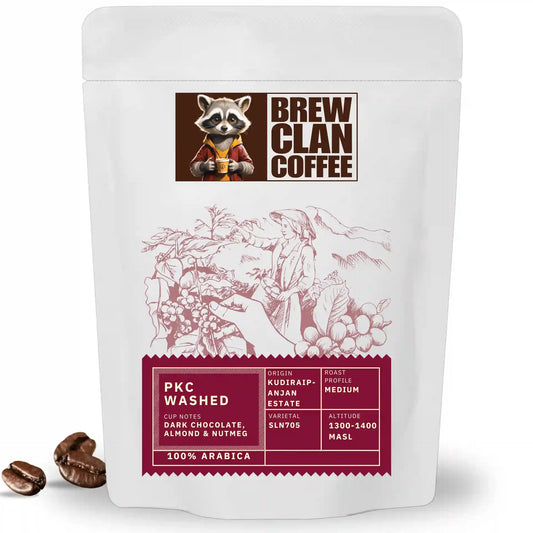
🍫 Best for a Complex Cup: PKC Kudiraipanjan Estate Washed

Origin: Kudiraipanjan Estate, Shevaroy Hills, Yercaud — 1300–1400 MASL | Tasting Notes: Dark Chocolate, Almond, Nutmeg | Roast: Medium | ~₹749
If you want your French press to taste like something genuinely interesting — a cup you actually think about while you're drinking it — this is the one. The PKC Kudiraipanjan Estate Washed is our most nuanced coffee for immersion brewing.
The washed process gives it a clean, structured foundation. The medium roast preserves the complexity of the SLN705 varietal. And in a French press, where all those flavour compounds have four full minutes to develop in the water, you get a cup that layers beautifully — dark chocolate opens, almond smoothness fills the middle, and a warm nutmeg spice arrives at the finish.
It requires a slightly more careful hand than the medium-darks — water at 91–92°C, a proper coarse grind, and a gentle press — but the reward is a French press coffee that tastes genuinely café-quality.
Brew tip: Let it bloom for 30 seconds before filling the rest of the press. It makes a noticeable difference to clarity and flavour.
→ Buy PKC Kudiraipanjan Washed
🍐 Best for Something Different: Udayagiri Estate Whiskey Barrel

Origin: Udayagiri Estate, 1200–1300 MASL | Tasting Notes: Green Apple, Fermented Fruits, Black Tea | Roast: Medium | ~₹849
French press is one of the best ways to experience the Udayagiri Whiskey Barrel — and here's why. The metal mesh filter retains the natural oils from this barrel-aged coffee, and those oils carry a significant amount of its extraordinary character. Paper filters would strip half of what makes this coffee special.
In a French press, you get the full expression: green apple brightness, layered fermented fruit complexity, and that smooth, elegant black tea finish — all wrapped in the warmth of oak and the whiskey barrel's subtle influence. It's unlike any other French press coffee you've tried.
This is the coffee for slow Sunday mornings when you have time to sit with your cup and actually notice what's in it. A genuinely exceptional experience.
Brew tip: Brew slightly cooler — 90–91°C. The lower temperature preserves the delicate fruit and tea notes that make this coffee remarkable. A 4.5-minute steep brings out the full barrel complexity.
→ Buy Udayagiri Whiskey Barrel
🍬 Best for Sweet, Gentle Cups: C&T Estate Yellow Honey

Origin: C&T Estate, 900–1200 MASL | Tasting Notes: Pear, Peach, Walnut | Roast: Medium-Light | ~₹699
Not everyone wants a bold, heavy French press. If you prefer something lighter, fruitier, and naturally sweet — still full-bodied from the immersion brew but without the intensity of a medium-dark roast — the C&T Estate Yellow Honey is your coffee.
The honey process retains natural fruit sugars that give this coffee a lovely, inherent sweetness. In a French press, the pear and peach notes come through clearly alongside a soft walnut warmth in the finish. Medium-light roast, silky body, bright but gentle acidity.
If you've always assumed French press has to be dark and bold, this one will change your mind.
Brew tip: Use water at 91–92°C and steep for 3.5 minutes rather than 4 — the medium-light roast extracts a little faster and benefits from a slightly shorter brew time.
🍬 Most Approachable: Peaberry from Hosahalli Estate

Origin: Hosahalli Estate, 1050–1150 MASL | Tasting Notes: Brown Sugar, Overall Sweet | Roast: Medium | ~₹549
If you're new to specialty coffee and want to start with something that's genuinely hard to get wrong, start here. The Peaberry from Hosahalli Estate is naturally sweet, smooth, and approachable in a French press — brown sugar warmth, soft body, mild acidity, clean finish.
The round shape of peaberry beans roasts more evenly than regular flat beans, which means a more consistent extraction in the French press. Less bitterness, more sweetness, every time. At ₹549 it's also the most accessible entry point into specialty coffee we offer.
Brew tip: Standard coarse grind, 92°C water, 4-minute steep. It's genuinely forgiving — great for building confidence with French press brewing.
At a Glance: Which French Press Coffee Is Right for You?
| Coffee | Flavour | Roast | Best For | Price |
|---|---|---|---|---|
| Mysore Nuggets | Chocolate, Cocoa, Nutty | Medium-Dark | Bold classic morning cup | ₹699 |
| Baarbara Washed AA | Cocoa, Brown Sugar, Nutty | Medium-Dark | Reliable everyday brew | ₹699 |
| PKC Kudiraipanjan | Dark Chocolate, Almond, Nutmeg | Medium | Complex, layered cup | ₹749 |
| Udayagiri Whiskey Barrel | Green Apple, Fermented Fruits, Black Tea | Medium | Adventurous weekend brew | ₹849 |
| C&T Yellow Honey | Pear, Peach, Walnut | Medium-Light | Light, fruity, sweet | ₹699 |
| Peaberry | Brown Sugar, Sweet | Medium | Beginners, gentle drinkers | ₹549 |
How to Brew the Perfect French Press: Step by Step
You've got your beans. Here's the method that gets the most out of them.
What you need:
- French press
- Coarsely ground fresh coffee
- Hot water (92–94°C for medium-dark, 90–92°C for medium-light)
- A timer
- A scale if you have one (highly recommended)
The recipe:
- Ratio: 1:15 — 1 gram of coffee per 15ml of water
- For a standard 350ml French press: 23 grams of coffee
- For a 600ml French press: 40 grams of coffee
Step 1: Preheat your press Pour a little hot water into the empty French press, swirl it around, and discard. This keeps the temperature stable during brewing.
Step 2: Add your ground coffee Add your coarsely ground coffee to the press and give it a gentle shake to level the grounds.
Step 3: Bloom (optional but worth it) Pour just enough water to saturate the grounds — about twice the weight of your coffee — and wait 30 seconds. You'll see the grounds puff up and release CO₂. Fresh coffee blooms dramatically. This step improves flavour clarity noticeably.
Step 4: Fill and stir Pour the rest of your water in a steady stream. Give it one gentle stir to make sure all the grounds are submerged. Place the lid on top with the plunger pulled all the way up — don't press yet.
Step 5: Steep for 4 minutes Set your timer and walk away. Resist the urge to press early.
Step 6: Press slowly After 4 minutes, press the plunger down slowly and steadily. If it's very hard to press, your grind is too fine. If it falls through with no resistance, it's too coarse.
Step 7: Pour immediately Don't let the coffee sit in the press after plunging — the grounds are still in contact with the liquid and it will over-extract, turning bitter. Pour into your cup or a separate carafe straight away.
Common French Press Mistakes to Avoid
Using too fine a grind — the most common mistake. Gritty, muddy coffee is almost always a grind problem. Go coarser.
Leaving coffee in the press after plunging — over-extraction happens fast. Pour immediately.
Using boiling water — 100°C water scorches the grounds. Let it rest off the boil for 30–45 seconds first.
Not cleaning the press properly — old coffee oils turn rancid and make every subsequent brew taste stale and bitter. Disassemble and clean the filter mesh regularly.
Using old beans — French press retains oils, and those oils carry aroma and flavour. Stale beans have lost these compounds. Fresh beans make a dramatic difference.
Related reads:
- How to Make the Best Pour Over Coffee at Home
- Peaberry Coffee Beans: What Makes Them Special?
- What "Specialty Grade" Actually Means — And How to Spot It
All BrewClan coffees are specialty grade, small-batch roasted, and shipped fresh across India. Free delivery on all orders.
→ Shop the Best Coffee Beans for French Press
Frequently Asked Questions
What grind size is best for French press?
Coarse — roughly the texture of coarse sea salt or breadcrumbs. Too fine and the grounds pass through the metal filter and make the coffee gritty and bitter. A coarse grind stays above the filter and extracts evenly over the 4-minute steep.
What roast is best for French press coffee?
Medium to medium-dark roasts work best. They extract fully during immersion brewing and produce the rich, full-bodied cup French press is known for. Light roasts can work but require more precision and tend to produce thinner cups.
How long should I steep French press coffee?
4 minutes is the standard. Medium-light roasts can do well at 3.5 minutes. Beyond 5 minutes and most coffees start to over-extract and turn bitter.
Can I use pre-ground coffee for French press?
You can, but freshly ground beans make a significant difference — especially in French press, which retains the coffee's natural oils and aromatics. If buying pre-ground, choose coarse grind specifically and use it within a week of opening for best results.
Why is my French press coffee bitter?
Most likely your grind is too fine, your steep time is too long, or your water is too hot. Try going coarser first — it fixes bitterness more reliably than any other adjustment. If bitterness persists, check your beans — stale or low-quality beans taste predominantly bitter in an immersion brew.
Why is my French press coffee weak and watery?
Your grind is too coarse or your steep time is too short. Try going slightly finer or extending the steep by 30 seconds. Also check your coffee-to-water ratio — a common mistake is using too little coffee.
Is French press coffee stronger than drip coffee?
Generally yes — French press retains more oils and fine particles than filtered drip coffee, which gives it a heavier body and often a more intense flavour. However, "strength" also depends on your coffee-to-water ratio, which you can adjust to taste.