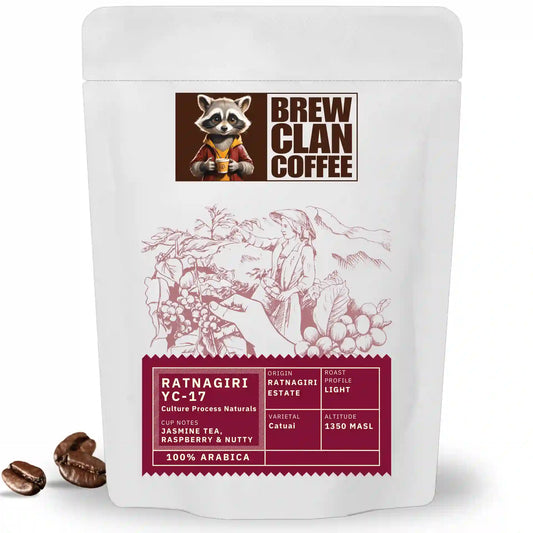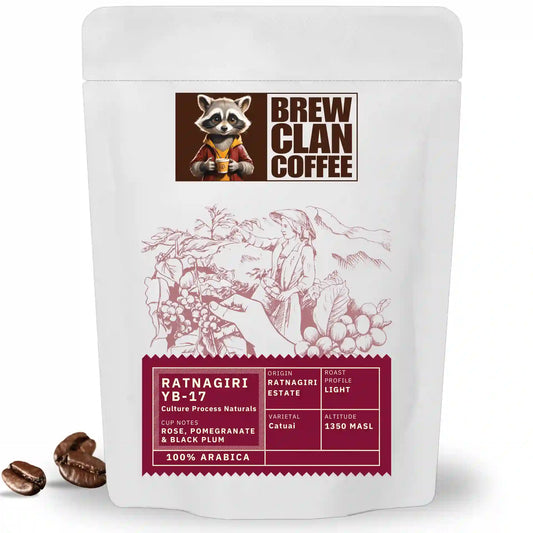

Natural vs Washed vs Honey Processed Coffee | What's the Difference and Which Should You Choose?
Share
Okay, so you're looking at a bag of specialty coffee and you notice it says "washed" or "natural" or "honey processed" somewhere on the label. Maybe you've seen these words before. Maybe you've wondered what they actually mean but never quite got around to finding out.
Let's fix that right now.
These words — natural, washed, honey — describe how the coffee was processed after it was harvested. And here's the thing: this single step in the coffee's journey has a massive impact on what ends up in your cup. We're talking about the difference between a coffee that tastes fruity and wine-like versus one that tastes clean and chocolatey. Same origin, same farm, sometimes even the same tree — but a completely different cup because of how the coffee was handled after picking.
So let's walk through it together.
First — What Are We Actually Processing?
Before we talk about the methods, let's quickly get clear on what coffee actually is at the point of harvest.
Coffee grows as a fruit. A coffee cherry, to be specific — a small, round, brightly coloured fruit that looks a bit like a cranberry when it's ripe. Inside that cherry, protected by several layers of skin, pulp, and a sticky mucilage, are two seeds. Those seeds are what we eventually roast and brew. What we call a "coffee bean" is just the seed of a coffee fruit.
When coffee is harvested, the farmer now has to figure out how to get from "fruit" to "dried seed ready for roasting." That's what processing is — the method used to remove all those layers and dry the seed properly.
And it turns out, the way you do this changes the flavour dramatically.
Method 1: Washed Process (Also Called Wet Process)
What happens
In the washed process, the cherry skin and pulp are removed from the seed almost immediately after harvest — usually within a day. The seeds then go through a fermentation stage, where they sit in water tanks for 24–72 hours. During this time, microorganisms break down the sticky mucilage coating on the outside of the seed.
After fermentation, the seeds are thoroughly washed with clean water — which is where the name comes from — and then laid out to dry on raised beds or patios until they reach the right moisture level.
What it tastes like
Because the fruit is removed so early in the process, it has very little time to influence the seed. What you're left with is the pure, unadulterated character of the bean itself — the terroir, the varietal, the altitude, the soil.
Washed coffees tend to taste:
- Clean and clear — no muddy or fermented background notes
- Bright and defined — flavours are distinct and easy to identify
- Structured — there's a clarity to the cup that lets you really taste the origin character
- More acidic — in a positive, lively way, like biting into a fresh piece of fruit
If you've ever tasted a specialty coffee and immediately thought "wow, that's really clean" or "I can actually pick out specific flavours here" — it was probably a washed coffee.
Who it's for
Washed process is brilliant for people who want to understand what a specific origin or varietal tastes like. It's the most transparent process — there's nothing in between you and the bean's natural character. Coffee geeks tend to love washed coffees for exactly this reason.
It's also the most consistent and predictable method, which is why it's widely used in specialty coffee production.
BrewClan washed coffees
Several of our coffees use the washed process:
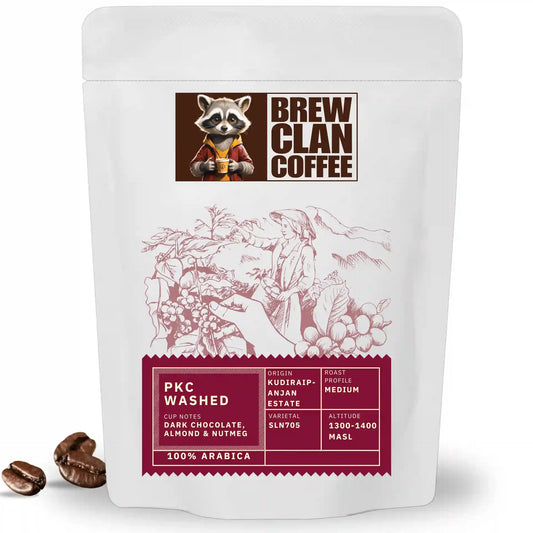
PKC Kudiraipanjan Estate Washed — Dark chocolate, almond, and nutmeg. A beautifully structured medium roast from the Shevaroy Hills in Yercaud, Tamil Nadu. The washed process gives it remarkable clarity — you can actually trace each flavour note distinctly in the cup.
Baarbara Estate Washed AA — Nutty, cocoa, brown sugar. High-altitude grown at 1350–1500 MASL, the washed process here produces a clean, sweet, full-bodied cup that's deeply satisfying.
Mysore Nuggets — Chocolate, nutty, cocoa. India's most iconic coffee style — the washed process keeps it clean, bold, and rich without any distracting ferment notes.
C&T Estate Washed AA — Deep chocolate, nutty, cocoa. Medium-dark, full-bodied, approachable. The washed process gives it a smoothness that makes it excellent across every brew method.
Method 2: Natural Process (Also Called Dry Process)
What happens
The natural process is the oldest coffee processing method in the world — and in some ways, the simplest. Instead of removing the cherry before drying, the whole intact fruit is laid out to dry with the seed still inside it.
The cherries are spread out on raised drying beds or patios and left in the sun, often for 3–6 weeks, turning regularly to ensure even drying. During this time, the fruit slowly dries around the seed, and as it does, the sugars and flavour compounds from the fruit gradually transfer into the seed.
Think of it like this: the seed is essentially marinating inside the drying fruit for weeks. By the time the cherry is dry and brittle enough to be hulled away, the seed inside has absorbed a significant amount of the fruit's character.
What it tastes like
Natural processed coffees taste dramatically different from washed coffees. The fruit influence is front and centre — you're not just tasting the bean, you're tasting what happened to it inside that cherry over weeks of drying.
Natural coffees tend to taste:
- Fruity and wine-like — intense fruit notes that can feel almost fermented or jammy
- Sweet and syrupy — naturally heavy sweetness from the fruit sugars absorbed during drying
- Full-bodied and heavy — a thicker, more viscous mouthfeel than washed coffees
- Complex and sometimes wild — the fermentation that happens during the long drying process creates flavours that can feel exotic, unusual, and deeply interesting
If you've ever had a coffee that made you stop and think "wait, is that actually blueberry?" — that was almost certainly a natural processed coffee.
Who it's for
Natural coffees are for people who want something adventurous and expressive. They're not necessarily more complex than washed coffees, but they're louder — more intense, more immediately striking. If you're the kind of person who wants your coffee to surprise you, naturals are exciting.
They're also typically sweeter and more approachable for people who find very acidic coffees harsh, since the fruit sweetness tends to balance and soften the acidity.
One thing to note: natural processing requires careful management. If done poorly, the fermentation can go wrong and produce unwanted sourness or off-flavours. Well-executed naturals are glorious. Poorly executed ones can taste fermented in a bad way. This is why the producer's skill matters enormously with natural coffees.
BrewClan natural coffees
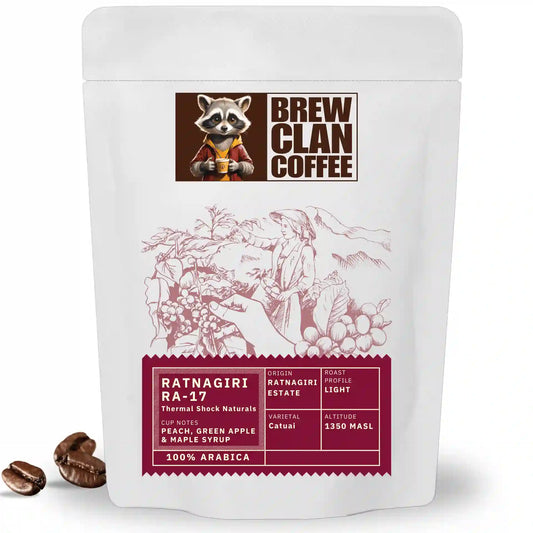
Our Ratnagiri Estate RA-17 Thermal Shock Naturals is a fascinating example of natural processing taken to another level. The RA-17 undergoes a pioneering thermal shock fermentation — where carefully controlled temperature shifts during the natural process coax out extraordinary layers of sweetness and fruit clarity. The result is peach, green apple, and maple syrup in the cup — vibrant, layered, and genuinely unlike anything else.
→ Buy Ratnagiri RA-17 Thermal Shock Naturals
Method 3: Honey Process (Also Called Pulped Natural)
What happens
If washed is one end of the spectrum and natural is the other, honey sits right in the middle — and it's where things get really interesting.
In honey processing, the cherry skin and some of the fruit pulp are removed — like in washed processing — but the sticky mucilage layer underneath is left on the seed intentionally. The seed is then dried with this mucilage still clinging to it.
The amount of mucilage left on determines the "colour" of the honey process:
- Yellow Honey — most of the mucilage removed, dried in open air with some shade. Closest to washed. Cleaner, brighter, lighter sweetness.
- Red Honey — more mucilage left on, dried with more shade and slower. More fruit influence, more sweetness, more body.
- Black Honey — maximum mucilage, very slow drying, minimum turning. The most natural-like of the honeys. Intense sweetness, heavy body, very fruit-forward.
The word "honey" here doesn't mean the coffee tastes like honey — it refers to the sticky, golden, honey-like appearance of the mucilage on the drying beans. Though, funnily enough, honey-processed coffees often do have a lovely natural sweetness to them.
What it tastes like
Honey coffees sit beautifully between the clarity of washed and the intensity of natural. You get more sweetness and body than a washed coffee, but more structure and cleanliness than a natural. The fruit notes are present but not overwhelming.
Honey coffees tend to taste:
- Naturally sweet — an intrinsic sweetness that doesn't need sugar to balance
- Fruit-forward but structured — you get fruit notes without the wild ferment character of a natural
- Silky and smooth — a lovely mouthfeel that's richer than washed but less heavy than natural
- Approachable and versatile — they tend to work well across a variety of brew methods
Honey processed coffees are increasingly popular in specialty coffee because they manage to be simultaneously interesting and accessible — you don't need an adventurous palate to enjoy them, but they reward one.
BrewClan honey processed coffees
We have two beautiful Yellow Honey coffees in our lineup:
Unnaki Estate Yellow Honey — Berry, apple, and grapefruit. A light roast honey coffee from Unnaki Estate at 1200–1300 MASL. Bright, fruity, and vibrant — the yellow honey process preserves the natural fruit character of the Chandra Giri varietal while keeping the cup clean and lively.
C&T Estate Yellow Honey — Pear, peach, and walnut. A medium-light roast with a silky body and lovely stone fruit sweetness. The honey process gives it a natural richness that makes it genuinely delightful through a pour over or Chemex.
→ Buy Unnaki Estate Yellow Honey
Side by Side: The Three Processes Compared
Let me put this all in one place so you can refer back to it easily.
| Washed | Honey | Natural | |
|---|---|---|---|
| Fruit removed? | Yes, immediately | Partially | No — whole fruit dries |
| Mucilage left on? | No | Yes | Yes (under skin) |
| Flavour character | Clean, bright, defined | Sweet, fruity, silky | Intense, fruity, complex |
| Acidity | Higher, livelier | Medium | Lower, softer |
| Body | Light to medium | Medium to full | Full, heavy |
| Sweetness | Natural bean sweetness | Enhanced by mucilage | High — fruit sugars absorbed |
| Consistency | Most consistent | Moderately consistent | Most variable |
| Best for | Clarity, origin character | Balance, sweetness | Adventure, intensity |
| BrewClan examples | Mysore Nuggets, PKC Kudiraipanjan, Baarbara, C&T Washed AA | Unnaki Yellow Honey, C&T Yellow Honey | Ratnagiri RA-17 |
So Which One Should You Choose?
Here's an honest guide based on what you're looking for:
"I want to understand what Indian specialty coffee tastes like at its most honest and clear." → Start with a washed coffee. Try Mysore Nuggets or PKC Kudiraipanjan Washed. The washed process lets the bean's natural character shine without interference.
"I want something sweet and fruity but not too wild." → Honey process is your answer. Try C&T Estate Yellow Honey or Unnaki Estate Yellow Honey. You'll get lovely fruit sweetness and a silky body without the intensity of a natural.
"I want something genuinely surprising and different." → Go natural. Try the Ratnagiri RA-17 Thermal Shock Naturals. It's extraordinary — peach, apple, maple syrup, all from a coffee bean grown in India.
"I'm new to specialty coffee and want something approachable." → Start with washed. Mysore Nuggets or Baarbara Estate Washed AA are forgiving, familiar, and delicious. No surprises, just great coffee.
"I already drink specialty coffee and want to explore." → Try one of each across three orders. Start with Mysore Nuggets (washed), then C&T Yellow Honey (honey), then Ratnagiri RA-17 (natural). You'll understand your own palate far better by the end of it.
Does Processing Method Affect How You Brew?
Slightly, yes. Here are a few practical notes:
Washed coffees work beautifully across all brew methods — drip, pour over, French press, espresso. They're consistent and forgiving.
Honey coffees shine brightest in pour over and Chemex, where the fruit sweetness and clean body come through most clearly. They also work well in cold brew.
Natural coffees love immersion methods — French press and AeroPress allow the full body and fruit complexity to develop fully. They can be trickier in espresso because the intensity can tip into sourness if not dialled in carefully, but when done right, a natural espresso is extraordinary.
A Final Thought
Processing method is one of those things that seems technical until you taste the difference yourself — and then it becomes one of the most interesting aspects of coffee.
If you've been drinking the same coffee for years without thinking about how it was processed, this is your invitation to explore. Order a washed coffee and a honey coffee from the same price point, brew them side by side, and taste the difference.
It's one of those moments that changes how you think about coffee permanently.
→ Explore All BrewClan Specialty Coffees
Frequently Asked Questions
What is the difference between washed and natural coffee?
Washed coffee has the fruit removed before drying, producing a clean, bright, structured cup that highlights the bean's natural character. Natural coffee is dried with the whole fruit intact, allowing fruit sugars and flavours to absorb into the bean, producing an intense, fruity, full-bodied cup.
What does honey processed coffee taste like?
Honey processed coffee sits between washed and natural — it tends to be naturally sweet, silky, and fruit-forward without the wild intensity of a natural. The fruit mucilage left on the bean during drying contributes sweetness and body while maintaining more structure than a fully natural coffee.
Which coffee processing method is best?
None is objectively best — each produces a different style of cup. Washed is best for clarity and origin character. Natural is best for sweetness and fruit intensity. Honey is best for balance and approachable sweetness. Your preference depends on what you enjoy in a cup.
Does processing method affect caffeine content?
No — processing method doesn't significantly affect caffeine content. Caffeine levels are primarily determined by the coffee species (Arabica vs Robusta) and varietal.
Why does natural processed coffee taste fruity?
Because the seed dries inside the fruit, it absorbs sugars and flavour compounds from the drying cherry over several weeks. This direct contact with the fruit pulp is what gives natural coffees their distinctive fruity, wine-like, and sometimes jammy character.
Is washed coffee less acidic than natural?
Actually, it's the opposite — washed coffees tend to have brighter, more noticeable acidity because the fruit is removed early and the bean's natural acids are more prominent. Natural coffees often taste lower in acidity because the fruit sweetness balances and softens it.
What is yellow honey coffee?
Yellow honey refers to a honey processed coffee where most of the mucilage is removed and the beans are dried relatively quickly in open air. It's the lightest of the honey variants — closer to washed in clarity and acidity, but with more natural sweetness and a slightly fuller body.
Are natural processed coffees harder to brew?
They can be slightly more demanding, especially in espresso, where their intensity can tip into sourness if the grind or extraction isn't dialled in carefully. In immersion methods like French press and AeroPress, naturals are actually quite forgiving and produce spectacular results.
Related reads:
- What "Specialty Grade" Actually Means — And How to Spot It
- Best Single Origin Coffee Beans to Buy Online in India
- How to Make the Best Pour Over Coffee at Home
All BrewClan coffees are specialty grade, small-batch roasted, and shipped fresh across India. Free delivery on all orders.