
Espresso Troubleshooting: When It's Your Grind vs When It's Your Coffee
Share
Bad espresso is one of the most frustrating things in home brewing. You've bought the machine, you've spent time dialling in your technique, and the shot still comes out tasting wrong. Too bitter. Too sour. Too weak. Runs too fast. Chokes the machine.
The tricky part is that almost every espresso problem has two possible culprits: your grind or your coffee. And they often produce symptoms that look identical on the surface.
This guide will help you diagnose exactly what's going wrong — and fix it quickly. We'll also show you which coffees actually make espresso troubleshooting easier, because some beans are genuinely more forgiving than others.
First: Understanding What Espresso Actually Is
Espresso is made by forcing hot water (around 90–94°C) through finely ground coffee at pressure (typically 9 bars). The entire extraction happens in 25–35 seconds.
That short window is why espresso is so sensitive. A small change in grind size, dose, or bean quality has an outsized effect on the final cup compared to slower brew methods like French press or drip. This is also why espresso is the best method for truly understanding your coffee — it magnifies everything, both the good and the bad.
The Two Big Variables: Grind vs Coffee
Before we get into symptoms and fixes, here's the most important mental model to carry into your troubleshooting:
Grind problems are usually about extraction rate — how fast or slow water moves through the puck. They show up as shots that run too fast, too slow, channel, or produce inconsistent results even when nothing has changed.
Coffee problems are usually about the raw material — stale beans, wrong roast level, wrong processing method for your taste. They show up as a persistent off-flavour that doesn't go away no matter how much you adjust the grind.
The diagnostic question to ask yourself: Does adjusting my grind make a noticeable difference to this problem? If yes, it's likely a grind issue. If you've tried multiple grind settings and the problem persists, look at the coffee.
Symptom by Symptom: Diagnosis and Fix
☕ Your Espresso Tastes Bitter
What it feels like: Harsh, dry, almost astringent. Lingers unpleasantly. Makes you wince slightly.
If it's your grind: Your grind is too fine, causing over-extraction — water is spending too long in contact with the grounds and pulling out harsh compounds along with the good stuff. Go one step coarser and pull again.
Also check: are you tamping too hard? Excessive tamp pressure compresses the puck too much and slows the shot down, causing over-extraction even with a correct grind.
If it's your coffee:
- Your beans are too dark roasted. Very dark roasts have already developed bitter compounds during roasting itself — no grind adjustment will remove them from the cup.
- Your beans are stale. Old coffee loses its nuanced flavors first and retains bitterness last — so a stale bag tastes predominantly harsh and flat.
- Your water is too hot. Above 94°C you start extracting harsh, bitter compounds more aggressively. Drop to 91–93°C.
Quick test: Pull the same shot at two grind settings — one slightly coarser, one slightly finer. If both taste bitter, it's the coffee. If one improves noticeably, it's the grind.
🍋 Your Espresso Tastes Sour
What it feels like: Sharp, acidic, almost vinegary. Unpleasant rather than bright. Feels harsh at the back of the throat.
If it's your grind: Your grind is too coarse, causing under-extraction — water is moving through the puck too quickly and not pulling out enough of the coffee's sweet, balancing compounds. The acids extract early; the sweetness never catches up. Go one step finer.
Also check: is your shot running in under 20 seconds? Fast shots are almost always under-extracted and sour.
If it's your coffee:
- Your beans are under-roasted or very lightly roasted. Light roasts are naturally more acidic — this is a feature, not a flaw, but they require more precision to pull correctly in espresso. If you prefer espresso-style drinks, medium or medium-dark roasts are more forgiving.
- Your beans are actually too fresh. In the first 2–3 days after roasting, beans are still off-gassing intensely and can produce uneven, sour shots. Let fresh beans rest for at least 5–7 days before pulling espresso.
- Low-quality or defective beans. Some sourness comes from under-ripe or defective cherries in the harvest — this is a sourness that no grind adjustment fixes.
The difference between good acidity and bad sourness: Good acidity in espresso is bright, clean, and reminds you of citrus or fruit. Bad sourness is sharp, harsh, and vinegary. If you're getting the former with a light roast, that's the coffee doing its job. If you're getting the latter, troubleshoot your grind first.
💧 Your Espresso Is Weak and Watery
What it feels like: Thin body, no crema, pale colour, tastes like coffee-flavoured water.
If it's your grind: Almost certainly too coarse. Water is blasting through the puck without extracting enough. This can also happen if your dose is too low — not enough coffee in the basket means the water has nothing to work with. Check both grind and dose (standard double shot: 18–20 grams in, 36–40 grams out).
If it's your coffee:
- Very stale beans. Old coffee has lost its volatile compounds and simply has nothing to give the water, regardless of how well you grind it.
- Wrong roast for espresso. Very light roasts are dense and resist extraction. If you're getting consistently weak shots and you're using a light roast, switch to medium or medium-dark.
- Low-quality beans without enough soluble flavor compounds to produce a proper shot.
⏱️ Your Shot Runs Too Fast (Under 20 Seconds)
Fast shots are almost always under-extracted — sour, weak, thin. The water is channeling through the path of least resistance rather than evenly extracting the whole puck.
Grind fixes first:
- Go finer — this is the primary fix
- Check your distribution before tamping: are the grounds level in the basket? Uneven distribution causes channeling even with a good grind
Then check the coffee:
- Old, light, or underdosed coffee collapses under pressure and channels easily
- Some naturals and honey-processed coffees are more prone to channeling due to their lower density after processing — they need a slightly finer grind than washed coffees
🐌 Your Shot Runs Too Slow (Over 35 Seconds) or Chokes
Slow shots usually over-extract — bitter, harsh, sometimes syrupy in an unpleasant way.
Grind fixes first:
- Go coarser — most common fix
- Check your tamp: are you tamping too hard? 15–20kg of pressure is plenty; you don't need to lean into it
- Check for clumps in your grounds — clumps create uneven resistance and slow the shot
Then check the coffee:
- Very fresh beans (roasted within 2–3 days) off-gas during extraction and can clog the puck. Rest your beans.
- Oily beans from very dark roasts can clog grinder burrs over time, affecting grind consistency and slowing shots.
🌊 Your Shot Is Channeling (Pale Streaks, Inconsistent Flow)
Channeling is when water finds a crack or gap in the puck and rushes through that path instead of extracting evenly. You'll see pale, watery streaks in the spent puck, or the shot stream will be uneven.
Grind and technique fixes:
- Distribute grounds evenly before tamping — use a finger or distribution tool to level them
- Tamp evenly and level — a crooked tamp creates pressure points
- Check your basket isn't worn or damaged
Coffee factors:
- Naturals and honeys are more prone to channeling than washed coffees — they may need a finer grind and more careful distribution
- Very fresh or very stale beans are both prone to channeling
The Roast Level Guide: What Works Best for Espresso
This is where bean selection makes a massive difference — and where many home brewers go wrong by using the wrong roast.
Light Roasts in Espresso: High acidity, floral and fruit notes, dense beans that resist extraction. Rewarding when dialled in correctly, but less forgiving. Require lower water temperature (90–92°C), finer grind, and careful distribution. Not recommended for beginners.
Medium Roasts in Espresso: The sweet spot. Balanced acidity, developed sweetness, plenty of flavor complexity. Easier to extract consistently. Great for both straight espresso and milk-based drinks.
Medium-Dark Roasts in Espresso: Low acidity, bold chocolate and caramel notes, forgiving extraction window. The most beginner-friendly. Works beautifully with milk. Can border on bitter if pushed too hard.
Dark Roasts in Espresso: Easy to extract but prone to bitterness. The roast itself dominates the flavour — you taste the roast more than the bean's origin character. Most commercial espresso blends use this profile for consistency and accessibility.
The BrewClan Bean Guide: Best Coffees for Espresso
Here's the honest guide to which of our coffees work best for espresso — with a note on what to expect and how forgiving each one is.
🥇 Most Forgiving for Beginners: Mysore Nuggets
Tasting Notes: Chocolate, Nutty, Cocoa | Roast: Medium-Dark | ₹699
If you're still dialling in your espresso and don't want to waste good coffee on bad shots, start here. Mysore Nuggets has a wide extraction window — medium-dark roast, naturally low acidity, full body. It's forgiving of minor grind errors and produces a rich, chocolatey shot even when the parameters aren't perfect.
In the cup: bold cocoa depth, warm nuttiness, low acidity, lingering finish. Pulls beautifully as straight espresso and holds its own in lattes and cappuccinos. The SLN9 varietal from C&T Estate is one of India's most reliable espresso beans.
☕ Best for Milk-Based Drinks: Baarbara Estate Washed AA
Tasting Notes: Nutty, Cocoa, Brown Sugar | Roast: Medium-Dark | ₹699
If flat whites, lattes, and cappuccinos are your thing, the Baarbara Estate Washed AA is your coffee. The high-altitude growing conditions (1350–1500 MASL) give it a natural sweetness and clean body that cuts through milk beautifully without getting lost.
Brown sugar sweetness and cocoa depth translate perfectly into a milk drink — you get that café-style cup at home. Also works well as a straight double shot for those who like a smooth, low-acid espresso.
→ Buy Baarbara Estate Washed AA
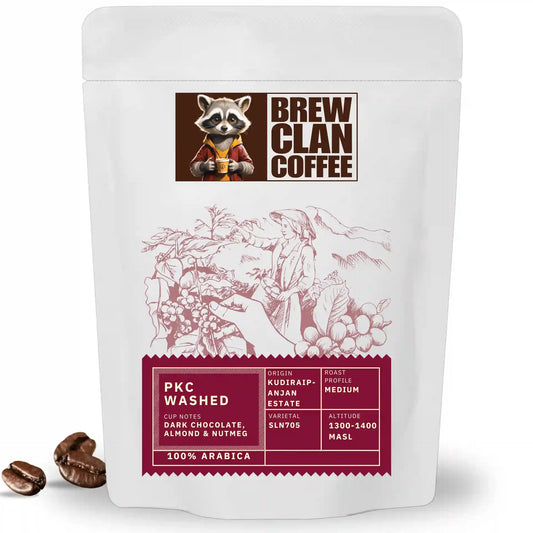
🍫 Best for Straight Espresso: PKC Kudiraipanjan Estate Washed
Tasting Notes: Dark Chocolate, Almond, Nutmeg | Roast: Medium | ₹749
The PKC Kudiraipanjan is the coffee for when you want to drink espresso and actually taste something interesting. The washed process gives it clarity and structure — a clean, well-defined shot with dark chocolate depth, almond nuttiness, and a surprising nutmeg spice at the finish.
Medium roast means slightly more precision required than the medium-darks, but the reward is a genuinely complex, café-quality shot. Excellent for those who take espresso seriously and want to taste the bean, not just the roast.
→ Buy PKC Kudiraipanjan Washed
🌟 Most Unique Espresso Experience: Udayagiri Estate Whiskey Barrel
Tasting Notes: Green Apple, Fermented Fruits, Black Tea | Roast: Medium | ₹849
Pull this as a ristretto (shorter, more concentrated shot) and you get something genuinely unforgettable. The whiskey barrel aging adds extraordinary complexity — oak warmth, fermented fruit depth, a black tea elegance — all concentrated into a small, intense shot.
Note: this one requires careful dialling in. The barrel-aging process affects the bean's density, so start with your usual grind setting and adjust from there. The payoff is worth the extra effort.
→ Buy Udayagiri Whiskey Barrel
Quick Guide: BrewClan Espresso Beans at a Glance
| Coffee | Roast | Espresso Style | Difficulty | Best For |
|---|---|---|---|---|
| Mysore Nuggets | Medium-Dark | Bold, chocolatey | Easy | Beginners, everyday shots |
| Baarbara Washed AA | Medium-Dark | Sweet, smooth | Easy | Milk drinks, lattes |
| PKC Kudiraipanjan | Medium | Complex, rich | Intermediate | Straight espresso lovers |
| Udayagiri Whiskey Barrel | Medium | Unique, layered | Advanced | Adventurous espresso fans |
The Golden Rule of Espresso Troubleshooting
Change one variable at a time.
This is the mistake almost every home barista makes when troubleshooting: they adjust the grind, change the dose, and switch to a different coffee all at once. Then the shot improves and they have no idea what actually fixed it.
Work systematically:
- Start with grind size — it's the most influential variable
- Then adjust dose — try +/- 1 gram
- Then adjust water temperature — try +/- 1–2°C
- Only change the coffee when you've exhausted grind and technique adjustments
Keep a simple log — even a notes app on your phone. Write down grind setting, dose, shot time, and tasting notes. Patterns will emerge quickly.
A Note on Equipment
No amount of troubleshooting fixes fundamentally inadequate equipment. If you're using a pressurised basket (common on entry-level machines), it masks grind inconsistency — which means you'll hit a ceiling on quality regardless of how good your beans are. Upgrading to an unpressurised basket (usually ₹500–1,500) opens up the full potential of specialty coffee in your machine.
Similarly, a burr grinder makes espresso dramatically more consistent than a blade grinder. Even a basic hand burr grinder (₹1,500–3,000) produces more uniform grounds than a blade grinder at any price.
Frequently Asked Questions
Why does my espresso taste bitter even after I've adjusted the grind? If bitterness persists across multiple grind settings, the problem is almost certainly the coffee — either too dark a roast, stale beans, or water that's too hot. Try fresh, medium-roast beans and brew at 92°C.
Why does my espresso taste sour even with a finer grind? Very fine grinds on a light roast can still produce sour shots if the beans are too fresh (under 5 days post-roast) or the water temperature is too low. Let your beans rest and try raising the brew temperature by 1–2°C.
How do I know if my coffee beans are too old for espresso? The bloom test works for espresso too — a fresh puck will slightly dome and expand during pre-infusion. Old beans produce a flat puck with little expansion. Also: if your shot is consistently weak and watery despite correct grind size, stale beans are the likely cause.
What's the ideal shot time for espresso? 25–35 seconds for a standard double shot (18–20g in, 36–40g out). Anything under 20 seconds is under-extracted; anything over 40 seconds is over-extracted.
Is Indian coffee good for espresso? Absolutely — Indian specialty coffees, particularly medium and medium-dark washed varieties from Coorg and Chikmagalur, are excellent for espresso. They have naturally low acidity, full body, and chocolate-forward profiles that translate beautifully into the format.
Should I use single origin or blended coffee for espresso? Both work. Blends are designed for consistency across espresso. Single origins give you more flavor character and traceability. BrewClan's medium and medium-dark single origins pull excellent shots and let you taste the origin — which is the whole point of specialty coffee.
Related reading: Why Is My Espresso Shot Sour, Bitter or Weak?
All BrewClan coffees are roasted fresh and shipped across India. Free delivery on all orders.